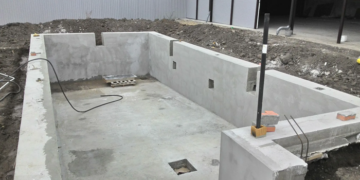




Concrete pools are valued for their strength, freedom of form, and the ability to fine-tune the design to suit the site: depth, steps, beach area, overflow, or skimmer.
However, it is precisely because of the “solid nature” of the materials that mistakes at the start are costly, so it’s important to proceed step by step and check key components before pouring and finishing.
A reliable result depends on three things: a competent design, proper waterproofing, and strict concrete supervision. Below are practical rules and tips to help you build a concrete pool without leaks, cracks, or equipment problems.
Concrete Pool Construction Technology: Key Rules
A concrete pool is a complex process: excavation work, foundation, reinforcement, concrete, waterproofing, finishing, and commissioning. Failure to follow the sequence or skimping on hidden layers almost always leads to leaks.
Excavation and Foundation
- Marking and excavation pit. Allowance is made for formwork, drainage, and process areas.
- Compaction and sub-concrete. The foundation is leveled, and a sub-concrete is laid for clean work on the reinforcement and waterproofing.
Reinforcement and Concreting
The basin must function as a monolithic structure. It is important to ensure a protective layer of concrete, proper reinforcement overlaps, and high-quality compaction of the mixture.
- Reinforcement cage. Adhere to the design pitch and diameters, use protective layer spacers, and avoid hanging mesh.
- Penetration and embedded parts. All embedded parts are installed strictly according to level, and abutments are sealed with specialized systems.
- Pouring. It is preferable to concrete the bottom and walls with minimal “cold joints”; vibration compaction is mandatory.
- Concrete curing. Protect against drying out and temperature fluctuations, maintain curing times.
Waterproofing: the main protection against leaks
A reliable system usually includes several barriers: structural concrete, joint treatment, leveling compounds, and final waterproofing under the finishing layer.
- Working with joints and abutments. Use waterstops/tapes, repair compounds, and cuffs at the inlets.
- Coating/penetrating waterproofing. Select a system compatible with the chosen finish and adhesive.
- Water testing. Before finishing, perform a test fill and curing, and record any level losses.
Finishing, Grouting, and Commissioning
For concrete pools, use tiles, mosaics, or PVC liners. For tiles and mosaics, a flexible adhesive and proper grouting that is resistant to chemicals and constant contact with water are critical.
- Tiles/Mosaics. Require a level base, adherence to expansion joints, and high-quality grouting.
- PVC liner. Faster to install and easier to repair, but surface preparation and careful welding are essential.
- Commissioning. Filtration adjustment, pH balance and disinfection, automation and heating system testing.
Practical advice: When comparing contractors and looking at examples of their work, evaluate not only their appearance but also the hidden stages: drainage, seams, embedded parts, pressure testing and leak test reports. Even if you’re choosing experienced specialists, such as pool contractors miami, inquire about the waterproofing systems they use and how they document quality control.
Checklist before paying for each stage: pool geometry checked for leveling; embedded parts installed and sealed; concrete compacted and cured; joints treated; waterproofing applied according to the manufacturer’s system; water testing conducted; finishing applied with compatible materials; equipment commissioned and configured.
Site Selection: Groundwater Level, Slopes, Trees
Choosing the right location for a concrete pool reduces the risk of cracks, basin subsidence, foundation erosion, and persistent water problems in the excavation pit. A mistake at this stage almost always results in costly remodeling because it affects the geology, structure, and drainage.
Assess the site in advance: where meltwater and rainwater accumulates, how the soil behaves after heavy rains, and whether there are slopes or nearby trees. Consider not only current conditions but also seasonal changes, especially in spring and after prolonged rainfall.
Key Factors
The groundwater level directly determines the drainage and stability requirements of the basin. The higher the water level, the greater the hydrostatic pressure on the structure and the greater the risk of erosion of the pad and the “floating” of the empty pool.
- Find out the seasonal maximum (usually in spring): use geological data, nearby wells/bores, and test pits as a guide.
- For high waters, install a ring drainage system and drainage system, as well as a way to lower the water level (drainage well/pump pit).
- Plan so that there is no “bowl” of terrain around the site where water will drain.
Slopes and terrain affect the amount of excavation work and the drainage of water from the site. A swimming pool is more convenient and it’s safer to place the garden on a relatively level part of the site or on a properly prepared terrace.
- Avoid low-lying areas: surface water accumulates there and soil moisture increases.
- If there’s a slope, consider retaining structures and organized drainage to prevent rainwater from flowing into the basin.
- Try to minimize elevation differences around the perimeter: this simplifies formwork, waterproofing, and subsequent landscaping.
Trees and their root systems are a common cause of problems: roots can lift and damage structures, while leaves and pollen increase water pollution and strain on filtration.
- Avoid placing the pool near large trees: roots can extend for distances comparable to the crown’s projection or more.
- Consider not only existing trees but also those that will grow: the situation changes in 5-10 years.
- If moving the pool is not possible, plan for protection in advance (root barrier, enhanced drainage, more frequent cleaning), but it’s best to choose a different location.
Bottom line: the optimal location for a concrete pool is away from low-lying areas, with a controlled slope and drainage, with a reduced risk of high groundwater, and away from large trees. This reduces the load on the structure, simplifies waterproofing, and ensures stable and predictable operation.